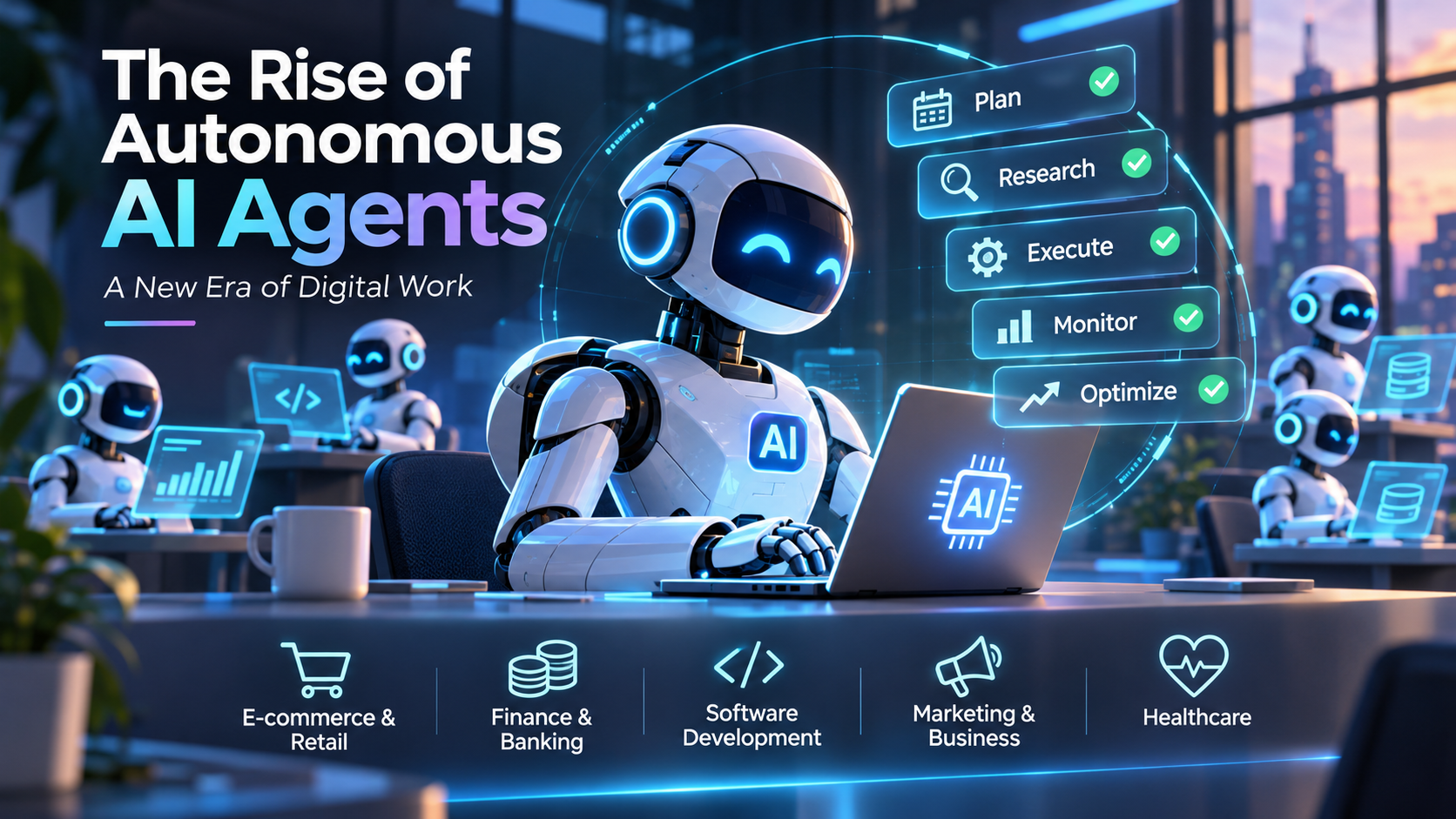
The Rise of Autonomous AI Agents: A New Era of Digital Work
Autonomous AI agents are transforming how businesses operate, make decisions, and create value. Moving beyond traditional chatbots and generative AI, these intelligent systems can independently plan, execute, and optimize complex tasks, reshaping the future of work and today’s global digital economy
Artificial intelligence is entering a new phase. For years, AI systems were primarily designed to analyze data, recognize patterns, generate content, and respond to human instructions. Today, a more advanced generation of intelligent systems is emerging: autonomous AI agents.
Unlike traditional AI applications, autonomous agents are designed not only to provide answers but also to take action. They can interpret objectives, develop strategies, use digital tools, evaluate results, and adjust their behavior with limited human intervention.
This evolution represents a fundamental shift in how individuals and organizations interact with technology. Instead of asking artificial intelligence to complete individual tasks, businesses can increasingly delegate entire workflows.
The transition from AI as an assistant to AI as an operational partner could become one of the most significant technological transformations of the digital age.
What Are Autonomous AI Agents?
Autonomous AI agents are intelligent software systems capable of pursuing specific objectives within defined environments.
They combine large language models, reasoning capabilities, memory, external tools, and decision-making mechanisms to perform multi-step operations.
A traditional chatbot might explain how to create a marketing campaign. An autonomous AI agent, by contrast, could research the target audience, develop campaign materials, prepare a distribution schedule, monitor performance, and recommend improvements.
The defining capabilities of autonomous AI agents include:
- Understanding objectives and contextual information.
- Planning and breaking down complex tasks.
- Accessing external applications and data sources.
- Executing actions within authorized boundaries.
- Evaluating outcomes and adapting strategies.
- Coordinating with other AI agents and human teams.
Autonomy does not necessarily mean unrestricted independence. Effective AI agents operate within clearly defined permissions, objectives, and governance frameworks.
Why Autonomous AI Agents Are Gaining Momentum
Several technological developments are accelerating the rise of autonomous AI agents. More capable language models, improved reasoning systems, cloud computing, API integrations, and declining AI processing costs are making these systems increasingly accessible.
At the same time, businesses are under growing pressure to improve productivity, reduce operational costs, and respond more quickly to changing market conditions.
According to EY's September 2026 AI Risk and Governance Survey, 91% of surveyed senior AI executives reported that their organizations were using agentic AI through pilot programs or enterprise deployments.
EY - US
The competitive advantage is gradually shifting from simply having access to artificial intelligence to knowing how to integrate it effectively into business operations.
From Automation to Autonomous Workflows
Traditional automation follows predefined rules. If a specific event occurs, the system performs a predetermined action.
Autonomous AI agents introduce a different approach. They can evaluate situations, interpret changing conditions, select appropriate tools, and determine the next course of action.
For example, an e-commerce AI agent could monitor inventory levels, analyze customer behavior, identify emerging product trends, recommend pricing adjustments, and prepare promotional campaigns.
Rather than automating a single process, businesses can create interconnected systems capable of managing multiple operational responsibilities.
This flexibility makes autonomous agents particularly valuable in environments where information, customer expectations, and market conditions change continuously.
How AI Agents Are Transforming Industries
The potential applications of autonomous AI agents extend across nearly every sector of the global economy.
E-commerce and Retail
AI agents can support inventory management, product recommendations, competitive pricing, customer service, and marketing optimization. Retailers can potentially deliver more personalized shopping experiences while improving operational efficiency.
Finance and Banking
Financial institutions can use agents to monitor transactions, identify unusual activities, analyze market developments, and prepare financial reports under appropriate regulatory and human oversight.
Software Development
Autonomous coding agents can write software, identify bugs, generate tests, review code, and assist with application deployment. Developers can focus more heavily on architecture, innovation, and strategic problem-solving.
Marketing and Business Development
AI agents can research markets, identify potential customers, develop content strategies, analyze campaign performance, and support customer acquisition activities.
Healthcare
Within carefully controlled environments, AI agents can assist healthcare professionals with administrative workflows, research analysis, appointment coordination, and medical documentation.
The Emergence of Multi-Agent Systems
One of the most promising developments in autonomous artificial intelligence is the emergence of multi-agent systems.
Instead of relying on a single AI agent to perform every task, organizations can deploy multiple specialized agents working together toward a shared objective.
A digital marketing operation, for example, could include a research agent, a content creation agent, a campaign management agent, and a performance analysis agent.
Each agent would have a specific responsibility, while a coordinating system would manage communication and workflow execution.
However, greater complexity does not automatically produce better results. Organizations must balance specialization against reliability, operational costs, and coordination challenges.
A New Opportunity for Startups
Autonomous AI agents are opening significant opportunities for entrepreneurs and technology startups.
The next generation of software companies may move beyond conventional subscription-based tools toward platforms that deliver measurable business outcomes.
Rather than selling access to marketing software, a startup could offer an AI-powered marketing operation. Instead of providing project management tools, it could deliver intelligent workflow coordination.
This creates opportunities for new business models, including AI Agent as a Service, industry-specific autonomous solutions, performance-based pricing, and AI agent marketplaces.
Startups that successfully combine industry expertise with artificial intelligence may be particularly well positioned to compete against established software providers.
The Future of Human Work
The rise of autonomous AI agents raises important questions about employment and professional responsibilities.
While some repetitive and administrative activities may become increasingly automated, new roles are also likely to emerge around AI orchestration, governance, workflow design, and strategic decision-making.
Human capabilities such as creativity, emotional intelligence, leadership, ethical judgment, and relationship management will remain essential.
The future workplace may increasingly consist of hybrid teams in which humans establish objectives and provide strategic direction while AI agents support execution.
Managing intelligent systems could become an important professional skill across many industries.
Security, Ethics, and Governance
Despite their potential, autonomous AI agents introduce significant challenges.
An AI system capable of taking independent actions can also make mistakes, expose sensitive information, generate unexpected costs, or execute unauthorized operations.
In August 2026, the National Institute of Standards and Technology highlighted the importance of strong identity management and authorization systems for agentic AI security.
NIST
Organizations must establish clear permissions, human approval mechanisms, accountability standards, monitoring systems, and emergency intervention procedures.
Trust will become a defining factor in the successful adoption of autonomous intelligence.
The most valuable AI agents will not necessarily be the most independent ones, but those capable of delivering reliable results within secure and transparent boundaries.
Conclusion: The Age of Autonomous Intelligence
The rise of autonomous AI agents represents more than another technological innovation. It signals a transformation in the relationship between humans, software, and business operations.
As intelligent systems become more capable, organizations will have opportunities to rethink productivity, innovation, customer experiences, and value creation.
However, success will depend on responsible implementation, effective governance, and meaningful collaboration between humans and artificial intelligence.
The next chapter of the digital economy may not be defined by who uses AI, but by who builds the most effective ecosystems of intelligent agents.
Artificial intelligence is moving beyond generating information. It is becoming an active participant in how work gets done.
The age of autonomous intelligence has begun.