AI-Powered Cybersecurity Threats: The Dark Side of Artificial Intelligence
AI-powered cybersecurity threats are transforming the digital risk landscape. From intelligent phishing and deepfake fraud to automated cyberattacks, businesses must rethink their security strategies to protect data, infrastructure, and trust in the age of artificial intelligence.
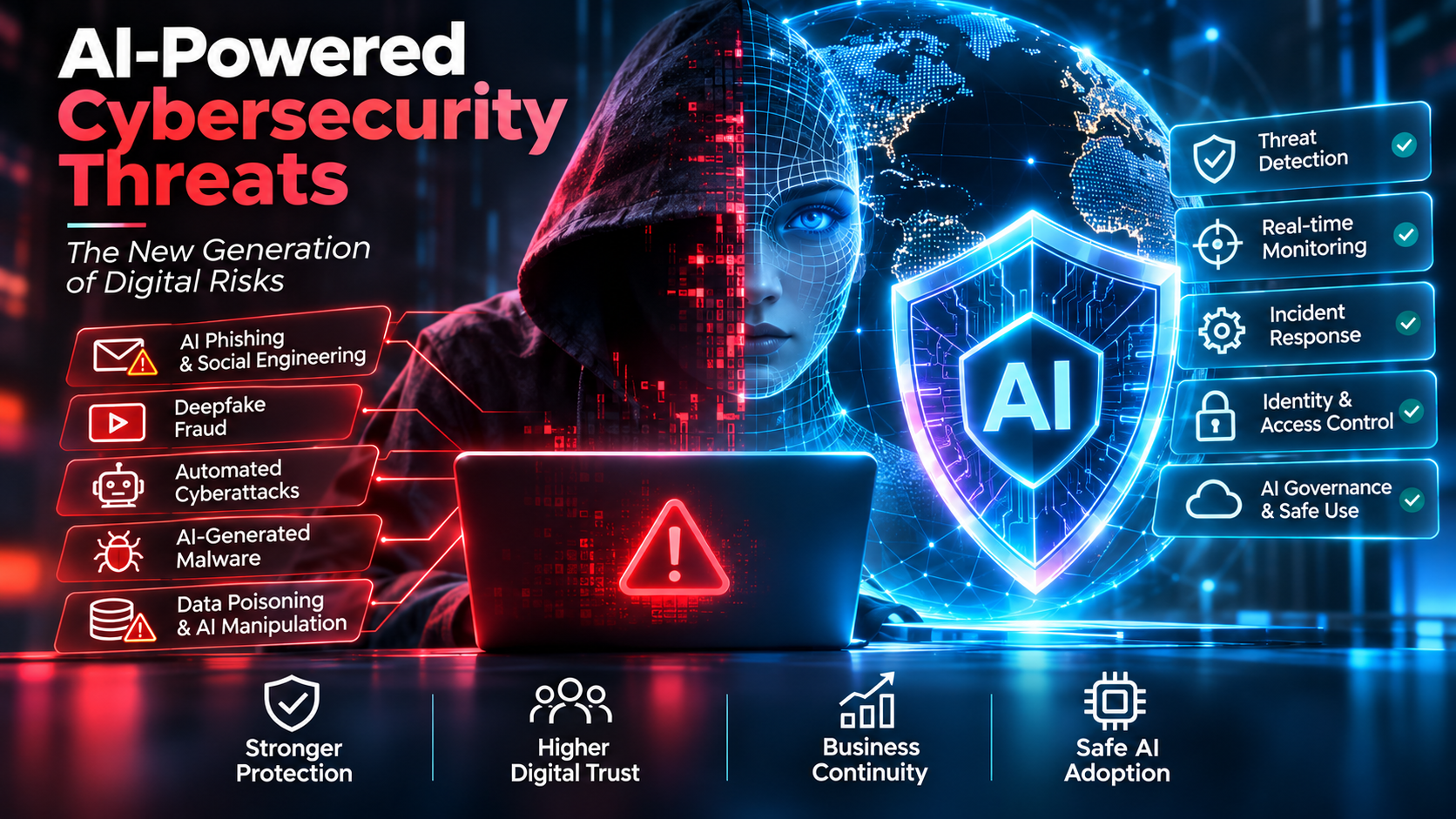
Artificial intelligence is transforming industries, accelerating innovation, and creating unprecedented opportunities for businesses worldwide. However, the same technologies that enable intelligent automation and operational efficiency are also introducing a new generation of cybersecurity threats.
Cybercriminals are increasingly using artificial intelligence to enhance their capabilities, automate malicious activities, and make digital deception more convincing.
Traditional cybersecurity threats are evolving into more sophisticated, adaptive, and scalable operations.
The challenge is no longer limited to protecting systems against human attackers. Organizations must also prepare for threats enhanced by intelligent software capable of processing information and adapting to changing environments.
As artificial intelligence becomes deeply integrated into the global economy, cybersecurity is becoming one of the most critical foundations of digital transformation.
How Artificial Intelligence Is Changing Cybercrime
Historically, sophisticated cyberattacks required substantial technical expertise, resources, and preparation. Artificial intelligence is lowering some of these barriers.
Generative AI can produce convincing fraudulent messages, imitate communication styles, and create realistic synthetic media. These capabilities can make social engineering campaigns more difficult to recognize.
The most significant transformation is the combination of speed, scale, and personalization.
Cybercriminals can potentially target larger audiences while tailoring deceptive content to individual recipients. Meanwhile, automated systems can increase the frequency of malicious activity.
This evolution is forcing businesses to reconsider traditional approaches to digital security. Protection strategies must become more adaptive, proactive, and intelligence-driven.
In November 2026, Google Threat Intelligence Group reported that malicious actors were increasingly incorporating autonomous AI workflows into their operations, highlighting a significant evolution in the cyber threat landscape.
Google Cloud Blog
AI-Powered Phishing and Social Engineering
Phishing remains one of the most common cybersecurity threats, but artificial intelligence is changing its effectiveness.
Traditional phishing emails often contained spelling errors, unusual expressions, and recognizable warning signs. Generative AI can now produce professional, contextually relevant, and highly convincing communications.
Fraudulent messages can appear to originate from executives, financial institutions, business partners, or trusted service providers.
This development creates significant challenges for organizations that rely primarily on employees to recognize suspicious communications.
Businesses must strengthen their identity verification procedures, implement phishing-resistant authentication, and continuously educate employees about emerging digital threats.
Deepfakes and the Crisis of Digital Trust
One of the most concerning applications of artificial intelligence is deepfake technology.
AI-generated audio, images, and videos can imitate real individuals with increasing accuracy. These capabilities create opportunities for financial fraud, corporate impersonation, identity theft, and reputational damage.
The FBI has warned that criminals are using generative AI to increase the credibility and scale of financial fraud schemes.
ic3.gov
For businesses, traditional forms of identity verification are becoming less reliable.
A familiar voice, recognizable face, or seemingly authentic video can no longer guarantee legitimacy.
Organizations must establish independent verification procedures, particularly for financial transactions, confidential information requests, and sensitive corporate decisions.
The Rise of Autonomous Cyber Threats
The emergence of autonomous AI agents introduces another dimension to cybersecurity.
While legitimate AI agents can improve productivity and manage complex workflows, malicious actors can also misuse automation to increase the scale and speed of cyber operations.
Security teams must prepare for an environment where threats can evolve faster than traditional manual response processes.
However, fully autonomous cyberattacks are not yet representative of every cybersecurity incident. Many observed threats still combine human decision-making with AI-assisted activities.
This distinction is important when developing realistic cybersecurity strategies.
When AI Systems Become the Target
Artificial intelligence is not only a tool that can amplify cybercrime. AI systems themselves introduce new security vulnerabilities.
Organizations integrating large language models and autonomous agents into their operations must consider emerging risks such as prompt injection, data poisoning, unauthorized data access, and manipulation of AI-generated outputs.
An AI agent connected to corporate applications, financial systems, or confidential databases may create significant security exposure if its permissions are not properly managed.
Businesses should adopt secure-by-design principles, restrict system privileges, monitor AI-generated actions, and require human approval for sensitive operations.
AI security must become an integral component of enterprise cybersecurity architecture.
AI as a Powerful Cybersecurity Defense
Despite these challenges, artificial intelligence also represents one of the most promising technologies for strengthening digital security.
AI-powered cybersecurity platforms can analyze large volumes of information, recognize unusual behavior, identify suspicious transactions, and support rapid incident response.
The UK's National Cyber Security Centre noted in its 2026 annual review that organizations with mature cybersecurity programs and effective AI governance are positioned to benefit from improved threat detection and automated defensive processes.
National Cyber Security Centre
The future of cybersecurity will increasingly involve intelligent systems working alongside experienced security professionals.
Zero Trust and the Future of Digital Security
Traditional security models often assume that users and devices operating within corporate networks can be trusted.
Zero Trust challenges this assumption by requiring continuous verification of identities, devices, permissions, and access requests.
As AI-generated impersonation becomes more convincing, Zero Trust principles will become increasingly important.
Organizations should prioritize phishing-resistant authentication, least-privilege access, continuous monitoring, secure backups, software updates, and comprehensive incident response procedures.
Cybersecurity must evolve from a collection of protective tools into a continuous organizational discipline.
New Opportunities for Cybersecurity Startups
The rise of AI-powered threats is creating significant opportunities for entrepreneurs and technology startups.
Emerging markets include deepfake detection, digital identity verification, AI agent security, automated threat intelligence, enterprise AI governance, and intelligent fraud prevention.
Small and medium-sized businesses represent a particularly important opportunity because many lack the resources to maintain dedicated cybersecurity teams.
Startups capable of delivering affordable, accessible, and reliable AI-powered security solutions could create substantial commercial value.
As digital trust becomes increasingly difficult to establish, technologies that help verify identities, protect information, and ensure the authenticity of digital interactions may become essential components of the global economy.
Cybersecurity as a Strategic Business Priority
Cybersecurity can no longer be considered solely an information technology responsibility.
A successful cyberattack can disrupt operations, damage customer relationships, expose intellectual property, and create substantial financial and legal consequences.
Business leaders must integrate cybersecurity into their broader corporate strategies, investment decisions, and digital transformation initiatives.
Security awareness should extend across every department, from finance and marketing to human resources and executive management.
Organizations that invest in cybersecurity resilience will be better positioned to protect their reputation and maintain customer confidence.
In an increasingly interconnected economy, digital trust is becoming a competitive advantage.
Conclusion: The Battle for Digital Trust
Artificial intelligence is fundamentally reshaping both sides of the cybersecurity landscape.
While malicious actors are gaining access to more sophisticated tools, businesses are also discovering powerful new technologies for protecting their digital environments.
The future will depend on the ability of organizations to combine intelligent security systems with human expertise, responsible governance, and continuous innovation.
Cybersecurity is no longer simply about protecting computers, networks, and databases. It is about protecting the trust that makes the digital economy possible.
Companies that recognize this transformation early will be better prepared to navigate an increasingly complex technological environment.
In the age of artificial intelligence, the most valuable digital asset may not be data or computing power, but trust itself.