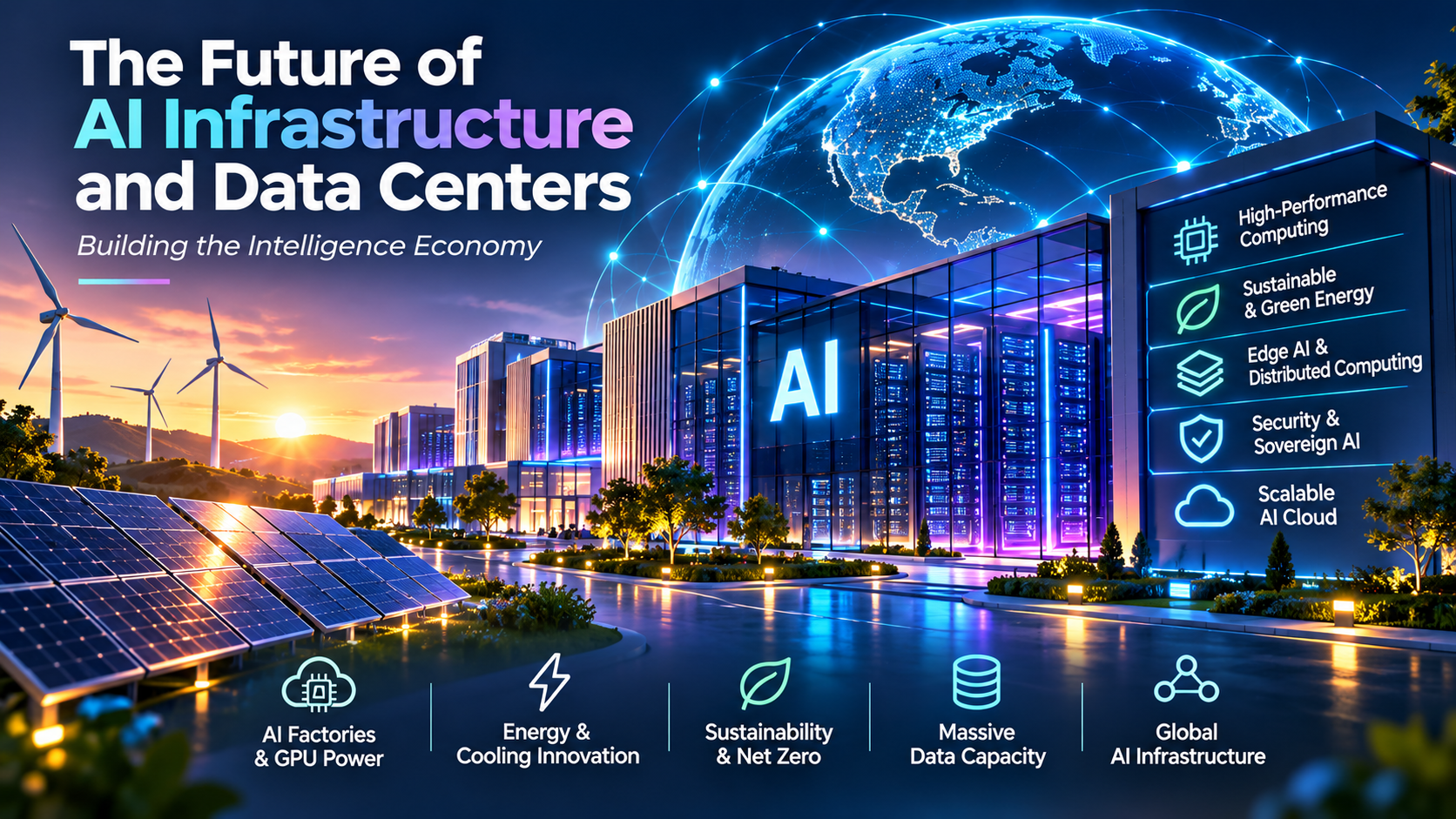
The Future of AI Infrastructure and Data Centers: Building the Intelligence Economy
AI infrastructure and data centers are becoming the backbone of the global digital economy. From advanced computing and sustainable energy to edge AI and intelligent cloud platforms, the race to build the next generation of digital infrastructure is accelerating.
Artificial intelligence is transforming how businesses operate, how people interact with technology, and how economies create value. However, behind every intelligent application, autonomous agent, and generative AI platform lies an extensive network of physical and digital infrastructure.
Data centers, advanced semiconductor chips, cloud computing platforms, high-speed networks, and energy systems form the foundation of the artificial intelligence revolution.
As AI adoption accelerates, the demand for computing power is creating new challenges and opportunities across the global technology ecosystem.
The next phase of artificial intelligence will not be defined exclusively by the intelligence of software. It will also depend on the capacity, efficiency, accessibility, and sustainability of the infrastructure supporting it.
AI infrastructure is becoming one of the most strategically important assets of the digital economy.
From Traditional Data Centers to AI Factories
Traditional data centers were primarily designed to store information, host applications, and support enterprise computing requirements.
AI-focused data centers operate under significantly different conditions. They require specialized processors, high-performance networking, advanced memory systems, and sophisticated cooling technologies.
The concept of an AI factory is emerging as a new infrastructure model. Rather than simply processing and storing information, these facilities transform data and computing resources into artificial intelligence capabilities.
They support model training, real-time inference, autonomous workflows, and large-scale intelligent applications.
This evolution represents a fundamental shift in the role of data centers, transforming them from supporting facilities into strategic engines of economic value.
The Growing Demand for Computing Power
The rapid expansion of generative AI, autonomous agents, intelligent search engines, and enterprise AI applications is driving unprecedented demand for computing resources.
Training advanced AI models requires substantial computational capacity. However, running these models continuously across millions of users introduces an additional challenge.
This process, known as AI inference, is becoming increasingly important as artificial intelligence moves from experimentation into everyday business operations.
Technology companies must balance processing performance with operational costs, energy consumption, and response times.
Future infrastructure providers will compete not only on computing capacity but also on their ability to deliver reliable, efficient, and affordable intelligence at scale.
The Global Race for AI Infrastructure
Major technology companies, including Microsoft, Amazon, Google, Meta, and Nvidia, are investing in the infrastructure required to support the growing AI economy.
Governments are also recognizing advanced computing infrastructure as a strategic national resource.
On November 27, 2026, Reuters reported that Japanese energy company JERA had entered discussions with Anthropic, Meta, and other American technology companies regarding potential data center developments near power generation facilities.
Reuters
Such developments demonstrate how artificial intelligence, energy production, and international investment are becoming increasingly interconnected.
Countries capable of providing reliable energy, advanced telecommunications networks, semiconductor access, and favorable investment environments could become important hubs in the global AI economy.
Energy: The Biggest Infrastructure Challenge
One of the most significant challenges facing the future of artificial intelligence is electricity consumption.
Advanced AI processors require substantial amounts of power. As computing density increases, data centers also require more sophisticated cooling and electricity distribution systems.
According to the International Energy Agency, global data center electricity demand increased by 17% in 2025. Its 2026 analysis projects that total data center electricity consumption could double by 2030, while consumption from AI-focused facilities could triple.
IEA+1
This growing demand is encouraging technology companies to explore renewable energy, nuclear power, battery storage, and more efficient computing architectures.
Access to reliable and affordable electricity could become one of the most important competitive advantages in the AI infrastructure market.
The Rise of Liquid Cooling Technologies
Traditional air-cooling systems are becoming insufficient for some high-density AI computing environments.
Advanced processors generate significant amounts of heat, creating demand for more effective thermal management solutions.
Direct-to-chip liquid cooling and immersion cooling are emerging as important alternatives for next-generation data centers.
The OECD's November 2026 Digital Economy and Society Outlook highlights advanced cooling and modular infrastructure design as important considerations for AI-ready facilities.
OECD
These technologies create new opportunities for companies specializing in thermal management, industrial engineering, infrastructure monitoring, and energy optimization.
The future of computing performance will increasingly depend on innovations that manage heat as efficiently as they manage information.
Edge AI and Distributed Intelligence
While large-scale data centers remain essential for advanced artificial intelligence, the future will also involve increasingly distributed computing environments.
Edge AI allows artificial intelligence applications to operate closer to where information is generated.
Instead of sending every request to a centralized cloud platform, intelligent systems can process certain tasks locally through smartphones, industrial equipment, vehicles, and regional computing facilities.
This approach can reduce response times, improve privacy, lower network requirements, and support applications that require real-time decision-making.
The combination of centralized AI factories and distributed edge computing could create a more flexible and resilient global infrastructure ecosystem.
The Emergence of Sovereign AI
Governments and enterprises are becoming increasingly concerned about their dependence on foreign computing infrastructure.
Sovereign AI refers to the ability of countries and organizations to develop, operate, and govern artificial intelligence systems using infrastructure and resources under their own control.
This concept is particularly relevant to industries handling sensitive information, including healthcare, finance, public administration, and telecommunications.
However, achieving technological sovereignty does not necessarily require complete independence.
International partnerships, regional infrastructure networks, and shared technology standards could provide practical alternatives to building entirely independent ecosystems.
New Business Opportunities for Startups
The expansion of AI infrastructure is creating significant opportunities for technology entrepreneurs beyond traditional data center development.
Promising areas include computing resource optimization, intelligent energy management, GPU marketplaces, AI cloud orchestration, model compression, edge computing, and infrastructure cybersecurity.
Startups that help businesses reduce AI operating costs could become particularly valuable as enterprises expand their use of intelligent applications.
Specialized cloud platforms may also emerge to serve industries with unique requirements related to performance, privacy, security, and regulatory compliance.
Entrepreneurs do not necessarily need to own large data centers to participate in the infrastructure economy. Developing intelligent solutions that improve the efficiency and accessibility of existing resources could represent an attractive business opportunity.
Sustainability and the Future of Green Data Centers
Environmental sustainability is becoming a central consideration in infrastructure development.
Data center operators must address electricity consumption, carbon emissions, water usage, electronic waste, and the environmental impact of construction.
Energy-efficient processors, renewable electricity, closed-loop cooling systems, waste heat recovery, and intelligent workload management could help reduce the environmental footprint of artificial intelligence.
However, efficiency improvements alone may not offset the environmental impact of rapidly growing demand.
The long-term success of AI infrastructure will require measurable sustainability strategies alongside technological innovation.
Conclusion: Building the Foundation of the AI Economy
Artificial intelligence is often perceived as a software revolution, but its future is deeply connected to the evolution of physical infrastructure.
Data centers, semiconductor technologies, energy systems, and global communication networks are becoming the foundations of a new economic landscape.
The organizations that succeed in this environment will be those capable of combining computing performance with affordability, accessibility, security, and sustainability.
For investors, entrepreneurs, and business leaders, AI infrastructure represents a significant long-term opportunity.
The next generation of technology leaders may not simply be the companies developing the most intelligent AI models, but those building the ecosystems that make artificial intelligence available to the world.
The future of intelligence will be determined not only by the algorithms we create, but by the infrastructure we build to power them.