The Global AI Chip War: The Battle for Technological Supremacy
The global AI chip war is reshaping technology, geopolitics, and the digital economy. As nations and tech giants compete for semiconductor dominance, access to advanced computing power is becoming a decisive factor in innovation, economic growth, and global influence.
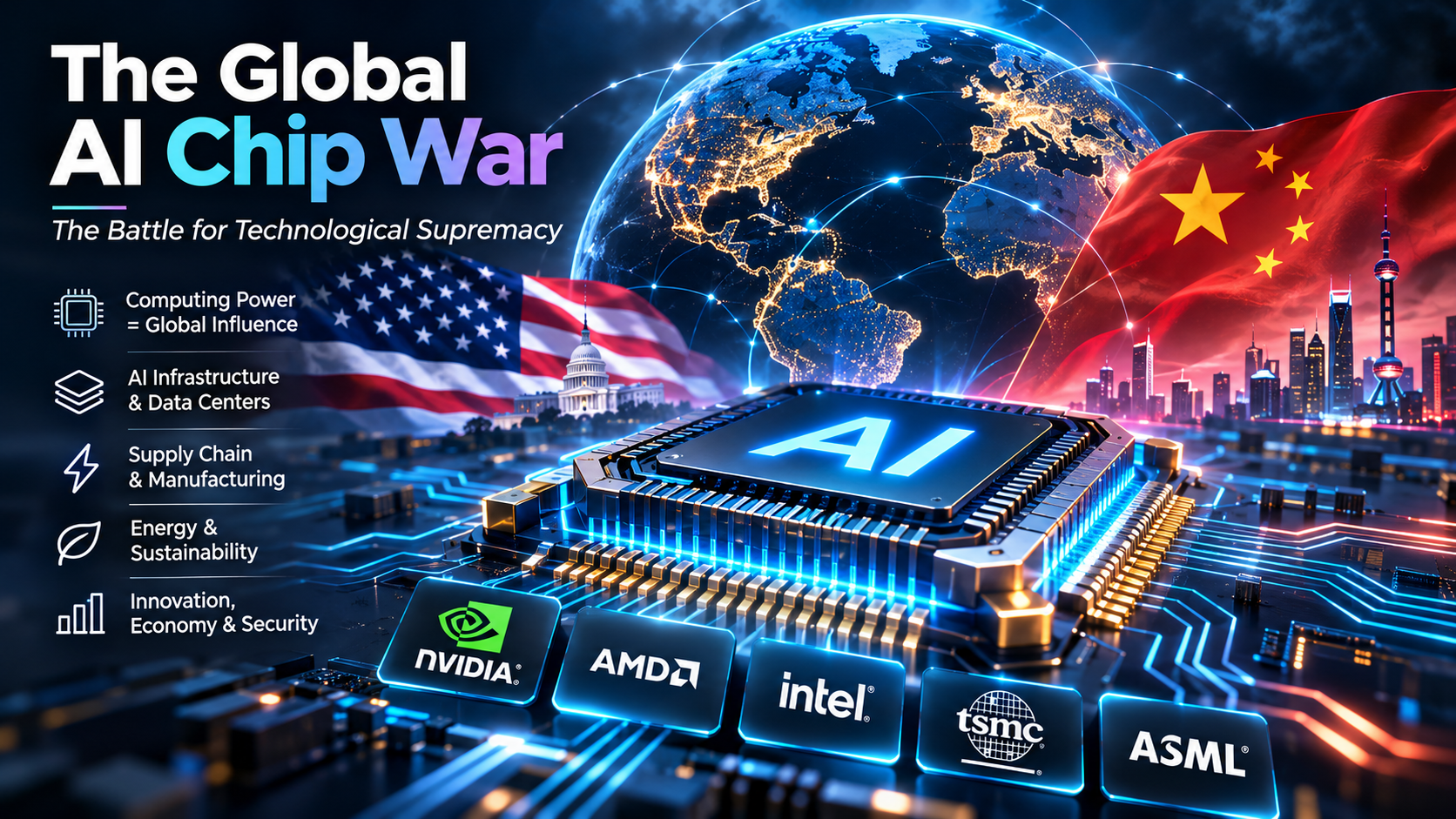
Artificial intelligence has become one of the most transformative technologies of the modern era. Behind every powerful AI model, autonomous agent, and intelligent digital platform lies a critical technological resource: advanced semiconductor chips.
These tiny components have become strategically important assets in the global economy. Their availability increasingly determines which companies can innovate, which countries can maintain technological leadership, and which economies can compete in an AI-driven world.
The competition for semiconductor dominance is no longer simply a commercial rivalry between technology companies. It has evolved into a geopolitical struggle involving governments, manufacturers, investors, and research institutions.
In 2026, the global AI chip war is becoming a defining element of international technological competition.
Why AI Chips Are So Important
Unlike conventional computer processors, advanced AI chips are specifically designed to perform enormous volumes of mathematical calculations simultaneously.
Training sophisticated artificial intelligence models requires substantial computing power. Operating these models at scale, particularly through autonomous AI agents, creates additional demand for high-performance infrastructure.
Graphics processing units (GPUs), tensor processing units (TPUs), and specialized AI accelerators have become essential components of this technological ecosystem.
The competitive advantage of these processors extends beyond speed. Energy efficiency, memory bandwidth, software compatibility, and scalability increasingly determine the commercial viability of AI applications.
For technology companies, access to advanced computing infrastructure can directly influence product development costs, innovation speed, and long-term profitability.
Nvidia and the Battle for Market Leadership
Nvidia has established itself as a central player in the artificial intelligence revolution.
Its success extends beyond semiconductor design. The company's combination of powerful processors, networking technologies, software libraries, and the CUDA ecosystem has created a comprehensive platform for artificial intelligence development.
However, competition is intensifying.
AMD is expanding its AI accelerator business, while Intel continues to pursue opportunities in semiconductor manufacturing and advanced computing.
Google, Amazon, Microsoft, and other major technology companies are developing specialized processors to reduce their dependence on external suppliers.
The next stage of competition will increasingly focus on the entire computing ecosystem rather than individual chip performance.
Companies capable of delivering affordable, scalable, and energy-efficient infrastructure may gain significant advantages as artificial intelligence becomes more widely adopted.
The United States and China: A Strategic Rivalry
The technological rivalry between the United States and China sits at the center of the global AI chip war.
The United States maintains significant strengths in advanced semiconductor design, AI software, and computing infrastructure. China, meanwhile, is investing heavily in developing domestic semiconductor capabilities and reducing its dependence on foreign technology.
American export restrictions have become an important component of this competition.
On November 19, 2026, new US regulations introduced additional licensing requirements targeting access to substantial advanced computing resources through certain overseas data centers. The measures demonstrate how semiconductor competition is expanding beyond physical chip exports into cloud-based computing infrastructure.
Reuters+1
From Washington's perspective, these restrictions address national security concerns. From Beijing's perspective, they create additional incentives to accelerate technological independence.
The long-term consequences could include increasingly fragmented technology ecosystems and competing infrastructure standards.
Taiwan's Critical Role in the Semiconductor Industry
Taiwan occupies a uniquely important position in the global semiconductor supply chain.
Taiwan Semiconductor Manufacturing Company (TSMC) manufactures advanced processors designed by many of the world's leading technology companies.
Its manufacturing expertise, production capacity, and technological capabilities make it an essential participant in the global AI economy.
This concentration of advanced manufacturing also creates strategic vulnerabilities. Governments and corporations are increasingly seeking to diversify semiconductor production geographically.
However, building semiconductor manufacturing facilities requires enormous capital investment, highly specialized engineering talent, sophisticated equipment, and years of development.
Replicating established manufacturing ecosystems is considerably more complicated than constructing individual factories.
Europe's Position in the Global Chip War
Europe may not dominate the AI accelerator market, but it possesses critical technological capabilities.
Dutch semiconductor equipment manufacturer ASML plays an essential role through its extreme ultraviolet lithography technology, which enables the manufacturing of advanced semiconductor components.
In September 2026, ASML and TSMC announced a collaboration involving next-generation lithography photomasks, demonstrating the continuing importance of European manufacturing technology.
Tue, 09/08/2026 - 08:04
Europe's opportunity lies in strengthening its semiconductor ecosystem through research, industrial innovation, manufacturing investment, and international partnerships.
Technological sovereignty is becoming an increasingly important consideration for European policymakers and businesses.
The Rise of Custom AI Chips
One of the most significant developments in semiconductor competition is the emergence of custom-designed AI processors.
Major cloud providers are developing specialized chips optimized for their own infrastructure and AI workloads.
Google's TPUs, Amazon's Trainium processors, and Microsoft's Maia accelerators illustrate this strategic direction.
Custom processors can potentially reduce operating expenses, improve energy efficiency, and provide greater control over technological infrastructure.
As artificial intelligence becomes embedded in everyday business applications, the economics of inference — running trained AI models — will become increasingly important.
The winning technology may not always be the most powerful processor. It may instead be the processor that delivers the greatest economic efficiency for a particular application.
New Opportunities for Startups
The global AI chip war is creating opportunities beyond traditional semiconductor manufacturing.
Startups can develop innovative solutions around computing optimization, cloud infrastructure, AI model compression, energy management, edge computing, and hardware-independent software.
As companies seek alternatives to expensive computing resources, technologies that reduce AI operating costs could become increasingly valuable.
Smaller, specialized artificial intelligence models may also offer competitive advantages in industries where large general-purpose models are unnecessary.
Entrepreneurs do not necessarily need to manufacture semiconductor chips to participate in this emerging economy.
Helping businesses use computing resources more efficiently could become an attractive and scalable business model.
The Energy Challenge Behind AI Infrastructure
The rapid expansion of artificial intelligence infrastructure is creating additional pressure on global energy systems.
Advanced data centers require substantial electricity, sophisticated cooling technologies, and reliable power infrastructure.
Consequently, semiconductor competition is increasingly connected to energy availability and environmental sustainability.
Future AI processors will need to balance computational performance with energy consumption.
Innovations in liquid cooling, advanced chip packaging, memory architecture, and renewable energy integration could become important sources of competitive differentiation.
The future of artificial intelligence depends not only on computational intelligence but also on the physical infrastructure required to sustain it.
Conclusion: Who Will Control the Future of AI?
The global AI chip war represents a fundamental transformation in technological and economic competition.
Its outcome will influence the development of artificial intelligence, international trade, startup ecosystems, industrial productivity, and national security.
While advanced semiconductor designers and manufacturers currently occupy influential positions, future leadership will depend on collaboration across hardware, software, energy, infrastructure, and research ecosystems.
No single company or country controls every essential component of the semiconductor supply chain.
The defining question of the AI era is therefore not simply who builds the most powerful artificial intelligence, but who can provide the infrastructure that makes intelligence accessible, affordable, scalable, and sustainable.
The race for artificial intelligence is also a race for computing power. Those who shape the future of silicon will help shape the future of the global economy.