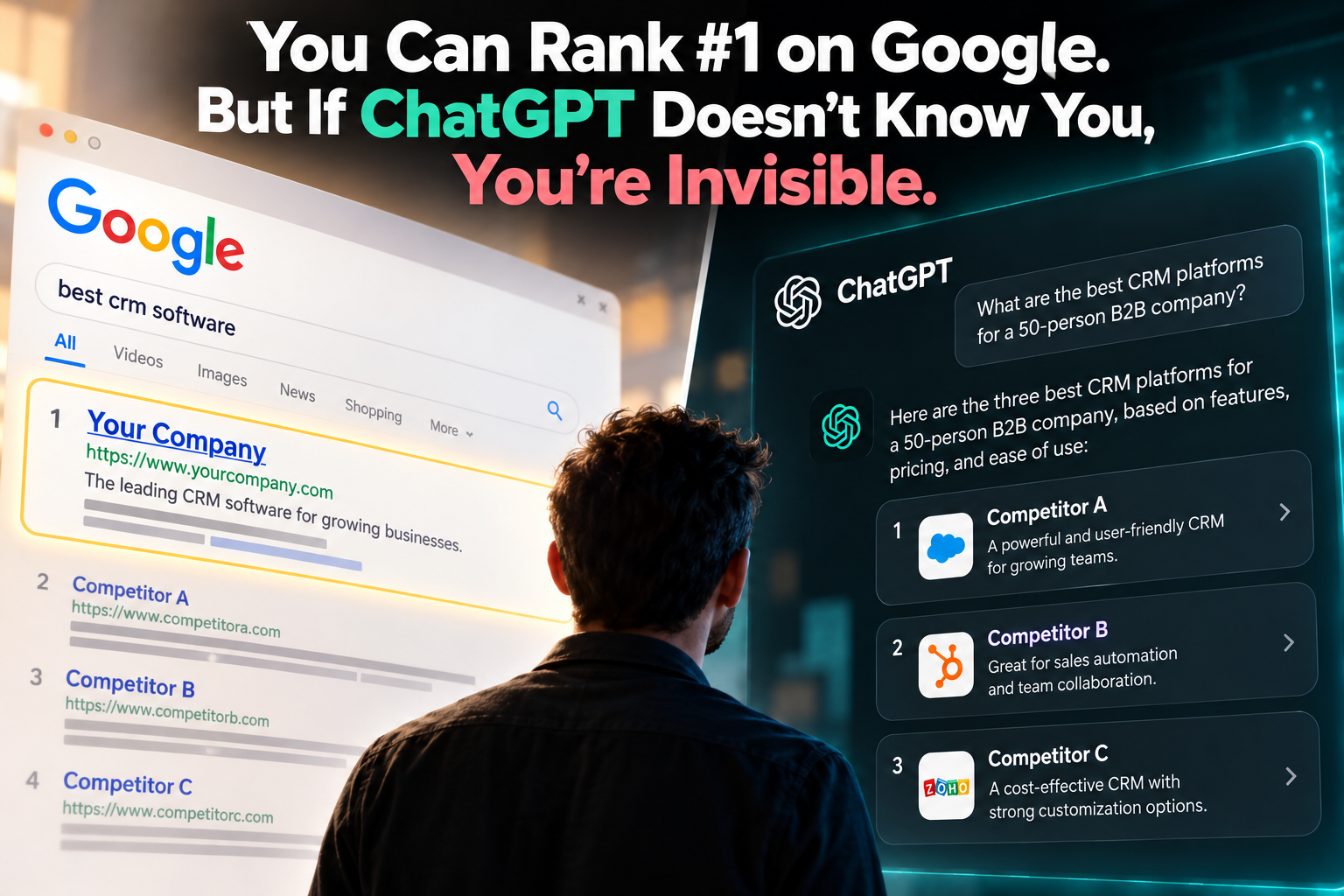
You Can Rank #1 on Google. But If ChatGPT Doesn’t Know You, You’re Invisible.
The rules of online visibility are quietly changing. For the past 20 years, a single question has defined digital marketing.“Where do we rank on Google?
SEO agencies were built around it.
Keyword strategies were created.
Backlink budgets were approved.
Thousands of blog posts were published.
But today, more and more discovery journeys are starting somewhere else.
On ChatGPT.
On Gemini.
On Perplexity.
And this shift is creating a new category:
AI Visibility
AI Visibility is your brand’s ability to be found, understood, cited, mentioned, and recommended by AI systems.
This does not mean SEO is dead.
It means digital visibility is no longer only about SEO.
Search behavior is changing
In the traditional search world, a user might type:
“Best CRM software”
Google would return a list of links.
The user would open several pages, compare products, read reviews, and make a decision.
Now the same person can ask an AI assistant:
“What are the three best affordable CRM platforms for a 50-person B2B company?”
That looks like a small change.
It isn’t.
Search engines traditionally helped users find options.
AI systems increasingly help users evaluate options.
And in many cases, they are already creating the shortlist.
That creates a new question every brand should be asking:
Does AI recommend us?
Because if your brand is not inside the answer, the user may never discover you.
AI traffic is no longer experimental
This shift is already becoming measurable.
AI-generated referral traffic to websites is increasing rapidly, while users arriving through AI platforms are often further along in the decision-making process.
That matters.
An AI-referred visitor may have already:
researched the category,
compared several solutions,
asked follow-up questions,
understood pricing,
and narrowed the market to a few brands.
By the time they reach your website, they may already have strong purchase intent.
This means AI Visibility is not only a brand awareness topic.
It is becoming a revenue and customer acquisition channel.
The new battle is not ranking. It is recommendation.
For years, the goal of SEO was simple:
Rank higher.
In the AI era, the goal is increasingly different:
Get recommended.
Imagine a user asking:
“What are the best premium footwear brands in Turkey?”
If an AI assistant recommends five brands and yours is number six, being number six may have almost no value.
The user may never see it.
This is one of the biggest differences between search engines and AI interfaces.
Google can show dozens of results.
AI often gives users a much shorter answer.
Three brands.
Five products.
A handful of recommendations.
That makes the new visibility economy much more competitive.
Brands may no longer be competing only for ranking positions.
They may be competing to enter the AI system’s shortlist.
Why does AI recommend one brand and ignore another?
There is a common misunderstanding about AI Visibility.
Some companies assume that if they mention their brand name repeatedly across their website, AI systems will automatically understand and recommend them.
It does not work that way.
AI Visibility is influenced by a much broader ecosystem of signals.
For example:
How clearly is your company described online?
How consistently is your brand positioned?
Do reputable external sources mention you?
Are your products and services easy to understand?
Do your pages answer specific customer questions?
Is your content structured clearly?
Do you use structured data?
Do independent publications reference your company?
Are reviews available?
Are there credible comparisons involving your product?
Is your expertise recognized outside your own website?
All these signals can contribute to how AI systems understand your brand.
That is why the future of search visibility will likely be broader than traditional SEO alone.
Alongside SEO, several new disciplines are emerging:
AEO — Answer Engine Optimization
GEO — Generative Engine Optimization
And above them sits a broader strategic idea:
AI Visibility.
The biggest mistake: creating content for AI
This may sound strange, but one of the biggest mistakes brands can make is trying too hard to create content “for AI.”
Because the best content for AI is often the same content that is genuinely useful for humans.
Clear.
Specific.
Well structured.
Fact-based.
Easy to understand.
Directly answering real questions.
A 2,000-word article filled with keyword repetition may be less valuable than four paragraphs that answer a highly specific question extremely well.
Instead of:
“CRM Software”
create:
“7 Things a 50-Person Company Should Consider Before Choosing a CRM.”
Instead of:
“Running Shoes”
create:
“Which Running Shoes Are Best for Flat Feet?”
Instead of:
“Hotels in Istanbul”
create:
“Best Bosphorus Hotels in Istanbul for Families With Children.”
The shift is important.
Content is moving from being purely keyword-centric to becoming increasingly question-centric and intent-centric.
Your next website visitor may not be human
This may become one of the most important digital changes of the next few years.
Until now, websites were primarily designed for humans.
Now there is another visitor to consider:
AI systems and AI agents.
These systems need to understand your business quickly.
Who are you?
What do you sell?
Who is your product for?
What makes you different?
How much does it cost?
Where is it available?
What are the benefits?
What are the limitations?
What are your return policies?
Why do customers choose you?
What problems do you solve?
If even a human visitor struggles to understand these things on your website, expecting an AI system to interpret your business perfectly may be unrealistic.
One of the core principles of AI Visibility is therefore surprisingly simple:
Explain your brand clearly enough for a machine to understand it.
A new set of marketing KPIs is coming
Today, marketing dashboards track metrics such as:
Organic Traffic
CTR
Conversion Rate
CAC
ROAS
Keyword Rankings
Soon, many companies may also begin tracking metrics like:
AI Mention Share
AI Citation Rate
AI Recommendation Rate
AI Referral Traffic
Competitor AI Visibility
AI Visibility Score
These metrics answer a very different set of questions.
How often does AI mention us?
Which competitors appear more frequently?
Which AI platforms recommend us?
For which questions do we appear?
Which sources are influencing those answers?
Why is a competitor being recommended instead of us?
This introduces a completely new measurement layer for digital marketing.
SEO is not dead. But SEO alone may no longer be enough.
Every major technological shift produces the same headline:
“SEO is dead.”
It isn’t.
SEO will likely remain extremely important for many years.
But its role is changing.
Because the customer journey now has an additional layer.
The traditional journey looked like this:
User → Google → Website
The emerging journey increasingly looks like:
User → AI → Recommendation → Website
And eventually, we may see more journeys that look like:
User → AI Agent → Purchase
When that happens, being indexed by Google will still matter.
But being understood, trusted, cited, and recommended by AI systems may matter just as much.
The real question
In 2026, companies should no longer ask only:
“Where do we rank on Google?”
They should also ask:
Does ChatGPT know our brand?
Does Gemini mention us?
Does Perplexity cite us?
When someone asks for the best companies in our category, are we included?
Why does AI recommend our competitor but not us?
What sources influence how AI describes our company?
And perhaps the most important question of all:
How does AI see our brand?
Because in the next phase of the internet, customers may not discover your company through your homepage.
They may discover it inside an AI-generated answer.
And whether your brand appears in that answer could become one of the most valuable competitive advantages in digital marketing.
SEO taught brands how to be found.
AI Visibility will teach them how to be recommended.